When comparing PC fans, two specifications often appear:
Airflow and static pressure.
Both matter, but they describe different parts of fan performance.
The right one to prioritize depends on where the fan is installed and how much resistance the air must move through.
What Is Airflow?
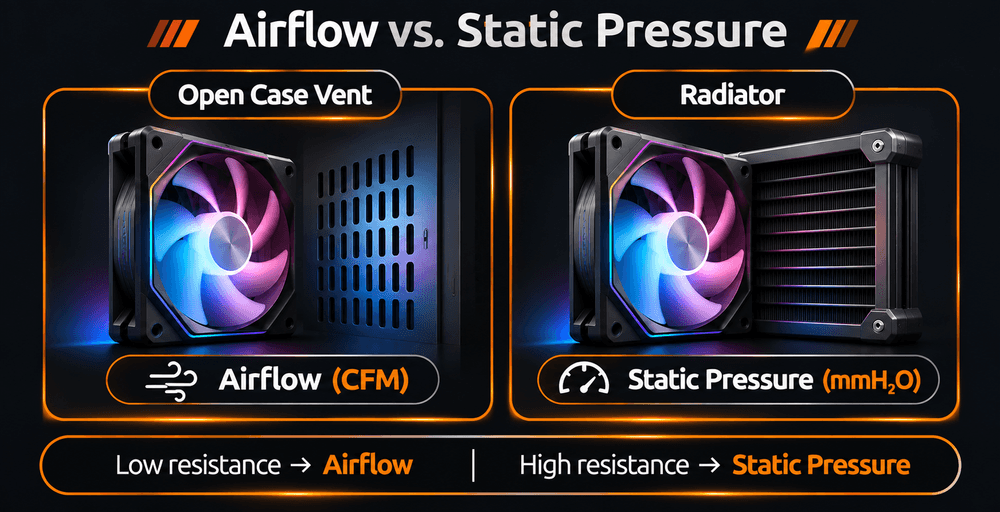
Airflow is usually measured in CFM, or cubic feet per minute.
It describes how much air a fan can move under a given test condition.
Higher airflow can be useful when the fan has relatively little resistance in front of or behind it.
Typical examples include:
Open case intake
Rear exhaust
Top exhaust
Large ventilation openings
In these positions, the main goal is often to move a larger volume of air through the case.
What Is Static Pressure?
Static pressure describes a fan’s ability to push or pull air against resistance.
It is usually measured in mmH₂O.
Static pressure becomes more important when airflow must pass through restrictive surfaces such as:
Radiators
Dense heatsinks
Dust filters
Tight mesh
Restricted intake openings
A fan may have a high free-air CFM rating but lose more airflow when placed behind a dense radiator or filter.
That is why CFM alone does not tell the full story.
Which Spec Matters for Case Fans?
For relatively open intake and exhaust positions, airflow is often a useful specification to consider.
But modern PC cases frequently include:
Dust filters
Mesh panels
Narrow ventilation openings
Decorative panels
These add resistance.
Because of this, even a case fan can benefit from reasonable static pressure.
The best choice is not always the fan with the highest CFM number.
It is the fan that can maintain useful airflow in the actual environment where it will be installed.
What About Radiators and Heatsinks?
Radiators and dense heatsinks create more airflow resistance than an open case vent.
In these situations, static pressure becomes more important.
The fan needs enough pressure to move air through the fins instead of simply moving air freely around them.
This is why radiator fans are often designed with blade shapes that emphasize pressure performance.
However, airflow still matters.
A radiator fan needs both enough pressure to overcome resistance and enough airflow to remove heat effectively.
Can One Fan Be Good at Both?
Yes.
Modern fan designs do not always fit neatly into “airflow fan” or “static-pressure fan” categories.
Many fans are designed to provide a balance of both.
Actual performance also depends on:
Fan speed
Blade design
Frame design
Motor characteristics
Noise level
The resistance of the case, filter, or radiator
This is why comparing only one specification can be misleading.
Which One Should You Prioritize?
As a practical starting point:
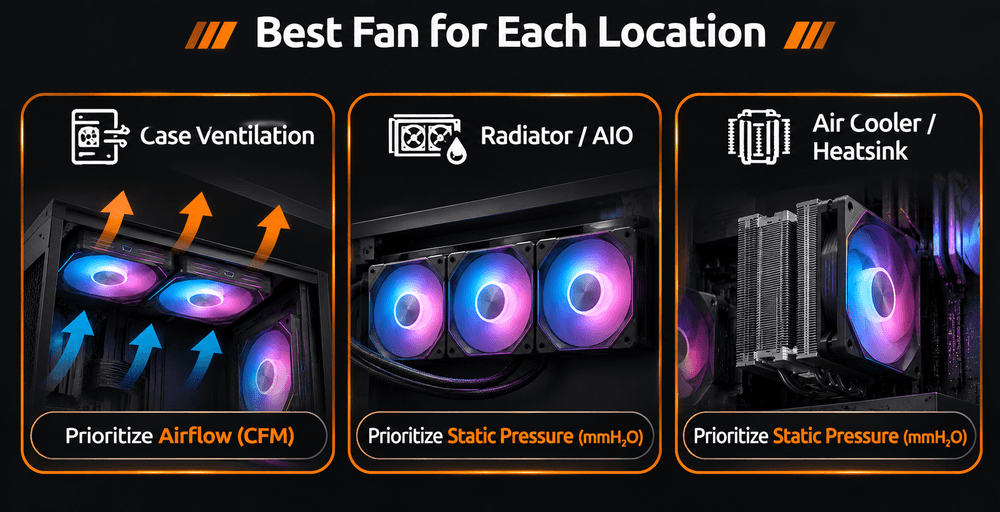
Open case intake or exhaust
→ Airflow is often more important.
Dust filters or restrictive mesh
→ Static pressure becomes more important.
Radiators and dense heatsinks
→ Static pressure should receive more attention.
But there is no universal cutoff.
The best fan is the one that provides enough airflow and pressure for the resistance in your specific setup.
Instead of asking which specification is better, ask:
How difficult is it for air to move through this mounting position?