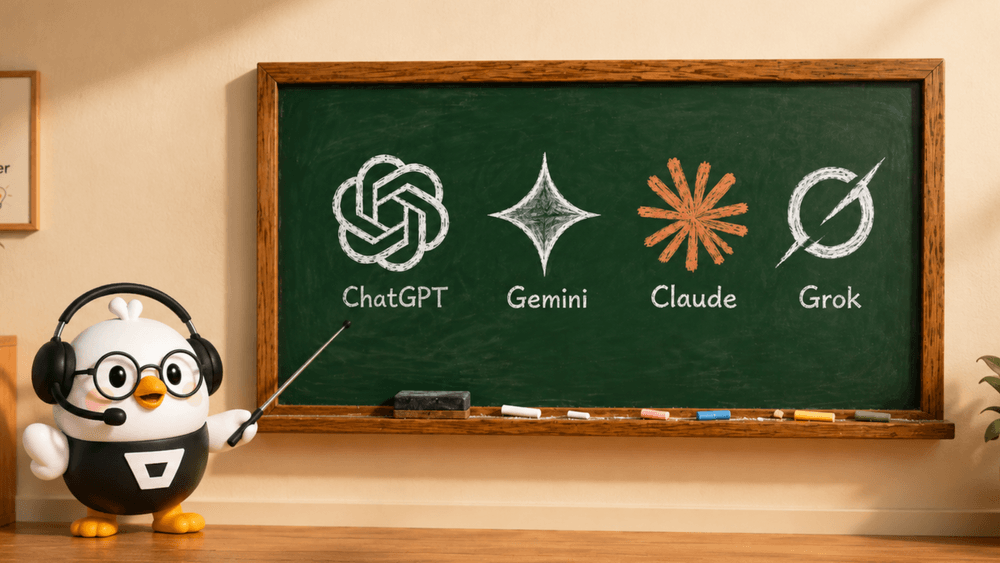
Which AI model should you use in 2026? GPT is more suitable for all-around AI assistant, Gemini is strongest for Google services and visual/video workflows, Claude is excellent for writing and code reasoning, and Grok is useful for real-time trends and social-first content ideas.
The fair answer is that there is no single “best” model for every user. If you need one general AI tool, GPT is the safest starting point. If your work lives in Google Workspace, Gemini is often more convenient. If you care about polished long-form writing, Claude is very strong. If you follow fast-moving social trends, Grok has a clear advantage.
ChatGPT: Suitable for General AI, Coding, and Image Generation
ChatGPT is the most balanced choice for general use. It works well for writing, translation, brainstorming, learning, summarizing, planning, coding, and structured problem-solving. Its biggest ecosystem advantage is Codex (ChatGPT APP), OpenAI’s coding agent that can help write, review, debug, and ship code across local or remote development environments.
ChatGPT is also strong for image generation: ChatGPT Images can create and edit images, adjust details, work with uploaded references, and generate visuals in different aspect ratios. However, OpenAI’s Sora web/app experience has been discontinued, so ChatGPT should not be described as the strongest consumer video-generation option right now.
Best for:
General AI assistant
Coding and debugging
Codex-based development workflows
Image generation and image editing
Writing, translation, planning, and research drafts
Not ideal for:
Native Google Workspace workflows
Users whose main need is video generation
Real-time social trend tracking as the core task
Gemini: Best for Google Workspace, Images, and Video Generation

Gemini is strongest when your workflow already depends on Google. It can connect with Gmail, Docs, Sheets, Slides, Drive, Calendar, and other Workspace tools, making it useful for summarizing emails, drafting documents, analyzing spreadsheets, preparing slides, and searching files.
Gemini is also one of the strongest choices for visual creation because Google supports image generation and editing through Nano Banana models, while Google Flow and Veo models support video generation workflows. For marketers, students, creators, and Workspace-heavy teams, Gemini may be more practical than GPT simply because it lives closer to the files and apps they already use.
Best for:
Gmail, Docs, Sheets, Slides, Drive, and Calendar users
Google Workspace productivity
Image generation and editing
Video generation with Veo / Flow
Marketing, social content, presentations, and planning
Not ideal for:
Users outside the Google ecosystem
Local coding or deployment tasks
Repo-level coding agent workflows
Claude: Best for Writing, Editing, and Code Reasoning

Claude is especially strong for long-form writing, editing, document analysis, careful reasoning, and code review. It is a good choice when tone, structure, and clarity matter, such as blog posts, white papers, technical documentation, scripts, reports, and detailed explanations.
Claude Code also supports programming workflows through a terminal-based tool. For image-related tasks, Claude can analyze uploaded images and create diagrams, charts, or interactive visuals using HTML/SVG, but Anthropic states that Claude does not generate photos or illustrations like dedicated image-generation tools.
Best for:
Long-form writing
Article editing and rewriting
Technical documentation
Code review and reasoning
Document analysis
Diagrams, charts, and structured visuals
Not ideal for:
Native photo or illustration generation
Video generation
Google-native productivity workflows
Real-time social trend monitoring
Grok: Best for Real-Time Trends, Social Research, and Grok Imagine
Grok’s biggest advantage is its social and real-time orientation. It is useful for tracking public conversations, fast-moving trends, memes, news reactions, and content angles from X-style discussions.
xAI also offers Grok Imagine, which supports image and video generation, including image editing, text-to-video, image-to-video, and video editing through supported models.
That gives Grok a stronger visual creation role than Claude, especially for users who want fast social-first creative ideas. Still, for polished long-form writing, deep workplace integration, or production coding workflows, GPT, Gemini, or Claude may be better depending on the task.
Best for:
Real-time trends
Social media topic discovery
Fast content ideation
Image and video generation with Grok Imagine
News reactions and meme-based angles
Not ideal for:
Polished long-form writing as the main task
Deep Google Workspace integration
Production-level coding workflows
High-stakes research without source checking
Final Thoughts: Build an AI Toolkit, Not a One-Model Habit
The best AI model in 2026 depends on the job.
Choose ChatGPT if you want the most flexible assistant with strong coding and image-generation tools.
Choose Gemini if you work inside Google services or need image and video creation.
Choose Claude if your priority is writing, editing, documentation, and code reasoning.
Choose Grok if you need real-time social trends and fast visual/content ideas.
For many users, the smartest setup is not one AI model, but a small toolkit: GPT for general work, Gemini for Google and video, Claude for writing, and Grok for trend discovery.